Hoffa clemency order
I Heard You Paint HousesThe Hoffa clemency order was both the instrument of Jimmy Hoffa’s release from prison and the means of keeping him from managing a labor organization until 1980. Signed by Richard Nixon on December 23, 1971, it reduced Hoffa’s sentence from thirteen years to six and a half, making his immediate release possible through good-time credit. The order thus ended his imprisonment while placing a new limit on the union power he expected to reclaim.
Petition and Release
On December 16, 1971, Morris Shenker filed a pardon petition at the White House. Instead of following the usual route through the Department of Justice for input from prosecutors and the FBI, and then the sentencing judges, the petition was marked approved by Attorney General John Mitchell. The procedure mattered: the decision that would free Hoffa and constrain his return to union life moved through an abbreviated channel, bypassing the usual review.
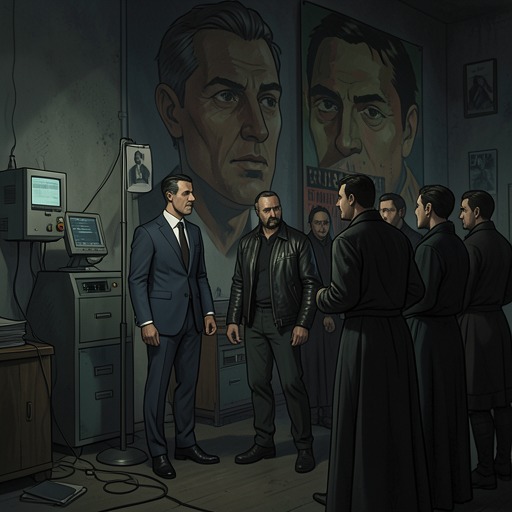
Frank Sheeran recalled visiting Hoffa at Lewisburg shortly before Christmas, where Shenker had brought papers Nixon was expected to sign. A guard looked the other way while Sheeran read them. As Sheeran remembered the document, it said Hoffa could be released after good-time credit and otherwise would leave in November 1975; he said it contained no restriction on running for office. At the time, the men understood the papers to mean that Hoffa was finally coming home, and discussed a few months in Florida before he returned to union activity. Sheeran’s recollection makes the difference between the papers seen in prison and the final order delivered later central to the episode.
The signed grant reduced the sentence to six and a half years, a term that, with good-time credit, guaranteed immediate release. Hoffa walked out of Lewisburg that day and flew to his married daughter’s home in St. Louis for Christmas. He then returned to Detroit to register with federal parole and probation officials. Although freed, he remained on parole until March 1973, when the full six-and-a-half-year term would have run. On January 5, 1972, he flew to Florida and his Blair House apartment in Miami Beach, beginning the respite his supporters had discussed.
The Restriction and Its Immediate Effect
The decisive condition stated that Hoffa was not to engage in the direct or indirect management of a labor organization before March 6, 1980; if he failed to comply, the commutation would become “null and void in its entirety.” The restriction extended well beyond his parole term. It meant that Hoffa could be out of prison yet barred from directing the union, including during the 1976 election period in which he had planned to seek a return to office.
Sheeran said the restriction became apparent when Hoffa reached Detroit and received the final papers bearing Nixon’s signature. In Sheeran’s account, the men had been happy in the Lewisburg lunchroom because the copy he read there promised release without mentioning the bar on officeholding. The later document transformed that relief into a perceived double-cross: Hoffa would be free, but could not resume union management until 1980. The book also notes that had Hoffa served the full sentence, he would have been released in 1975, in time for the 1976 convention. The commutation therefore exchanged earlier freedom for a restriction that reached beyond the prison gate and into his political future.
Hoffa did not immediately challenge the condition. He publicly said in February 1972 that he would support Nixon, and held back from confronting Frank Fitzsimmons while still on parole, fearing that the administration might monitor him more closely. He waited until his parole expired in March 1973 before pursuing a lawsuit. The delay shows the order’s practical force: even outside prison, the possibility of renewed federal scrutiny shaped when Hoffa was willing to contest the terms of his release.
Constitutional Challenge
Hoffa’s challenge rested on the difference between reducing a sentence and attaching a continuing prohibition to clemency. His lawyers argued that the president could grant or withhold a pardon but could not make a pardon conditional in a way that allowed it to be rescinded and the recipient returned to prison. They also argued that the restriction imposed a punishment—barring union management—that had not been part of Hoffa’s sentences and that the president had no authority to add after sentencing. A further claim was that the prohibition burdened Hoffa’s First Amendment rights to speech and assembly by excluding him from a forum for exercising them.
On March 13, 1974, Hoffa filed suit with civil-rights attorney Leonard Boudin. The complaint said Hoffa had not known of, or agreed to, the restriction when he left prison; it also alleged that the condition had not arisen through regular clemency procedures, but had been added through an agreement involving Charles Colson, special counsel to the president. Frank Fitzsimmons said he had known nothing about the restrictions. Colson said he had told Fitzsimmons before Hoffa’s release that the terms would be in the best interests of the labor movement and the country, but had not told him what they were.
On July 19, 1974, Judge John H. Pratt ruled against Hoffa in the United States District Court in Washington, D.C. The ruling treated the alleged Colson–Fitzsimmons arrangement as insufficient to invalidate the condition: even if the alleged conspiracy were proved, Nixon’s signature on the restriction remained effective. Hoffa and Boudin appealed, expecting the next stage to focus more directly on the constitutional questions, but the appeal would take another year or more. The clemency order’s significance therefore outlasted the moment of release: it freed Hoffa from prison, kept him from union management on the stated terms, and set the legal contest over presidential power in motion.